

Lockheed XF-90 – First Military Fighter with Afterburners – July 24,2026

The C-7 Caribou….The Workhorse of Vietnam – July 17, 2026
July 17, 2026
Pappy Chalk and Chalk’s International Airline – August 1, 2026
July 31, 2026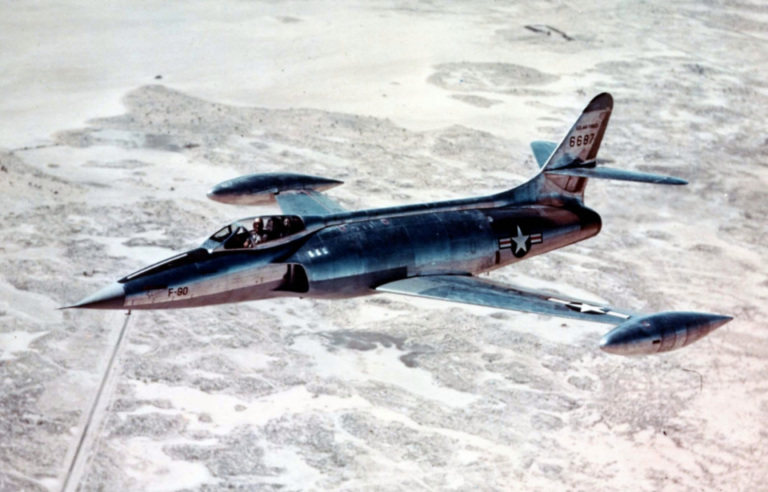
RN3DB
July 24, 2026
Good Morning,
Afterburners are common on most military aircraft but who produced the very first? It was Lockheed, and it was called the XF-90.
Enjoy…..
Lockheed XF-90
The Need for a “Penetration Fighter
Assuming their bombers would be dropping nuclear weapons in the next major war, the US Air Force made a requirement for a new escort aircraft that could follow bombers to and from their targets, ensuring their survival. This “penetration fighter” needed to be fast and have a long range.
Lockheed’s P-80 Shooting Star was the go-to jet fighter at the time, but as America’s first operational one, it was quite a poor performer. One of its main drawbacks was its straight wings, which limited its maximum speeds. Aircraft design legend Kelly Johnson proposed upgrading the aircraft with delta wings, which are excellent at high speeds, but this would have significantly hampered its low speed performance. In the end, Johnson and the Skunk Works team settled on swept wings. Power came from a pair of Westinghouse J34 turbojets, and wingtip fuel pods gave the aircraft an estimated range of 2,300 miles. It was also fitted with an ejection seat, a pressurized cockpit and an unusual vertical stabilizer that could move backwards and forwards. Overall, the aircraft shared some similarities to the P-80, but was a new design, designated the XF-90. The airframe was designed before supersonic flight was completely understood, so the team working on the aircraft over-engineered its airframe to ensure it would survive such speeds. It was built from 75ST aluminum, instead of 24ST that was typically used at the time. Many parts were forged and machined for strength. All of this made the XF-90 very strong, but also very heavy. Empty, it weighed over eight tons, more than a Douglas C-47 Skytrain. In comparison, the P-80 weighed less than four tons when empty. Its engines were simply not up to the task of powering an aircraft of this weight, and it had very poor performance.
Two examples of the aircraft were built: the XF-90 and the XF-90A. The “A” variant was equipped with afterburning J34 engines, which gave it a performance boost. It made its first flight on June 3, 1949. As expected, it proved to be sluggish and underpowered. Its heavy weight and slow acceleration meant it needed long distances to take-off and land, and once in the air its speed was unimpressive. The XF-90A was only able to hit 665 MPH, but was able to break the sound barrier in a dive. In 1950, the XF-90 was put against the McDonnell XF-88 Voodoo. Unsurprisingly, it lost, and the penetration fighter project was canceled soon after. The two XF-90s were no longer of use to Lockheed and were handed over to the departments that wanted the XF-90 was ship to the predecessor of NASA, where its aluminum frame was extensively studied in tests that eventually destroyed it. The XF-90A had a slightly more heroic end. It was given to the US government and quite literally blasted by atomic bombs.
The US was still learning about the effects of nuclear weapons at this time and one of the many questions posited was how well parked aircraft could deal with nuclear blasts. The XF-90A was placed on the Frenchman’s Flat testing range in Nevada, ready to be destroyed (or not). On April 15, 1952, a one-kiloton Mark 4 nuclear bomb was dropped over the range from a B-50 Superfortress. It hit the ground half a mile away from the XF-90A. The aircraft was inspected and, incredibly, was found to have only suffered a few cracks. With just 106 hours of repairs, it could have returned to service.
The following week, another test was conducted, this time with a 33-kiloton nuclear bomb. This caused more damage, particularly to the aircraft’s nose. In both tests, the aircraft faced the explosion, but on the third was turned sideways. The blast from a 19-kiloton nuclear bomb smashed into the XF-90A, ripping off its tail section and warping virtually every panel on the aircraft. The radioactive wreckage was moved to the desert in Nevada’s Area 11 and left.
Enjoy the weekend and join me next week for another look back at aviation history.
Robert Novell
July 24, 2026
